By Invite Only: The Tiny Discord Servers Where the Internet's Most Devoted Weirdos Actually Live
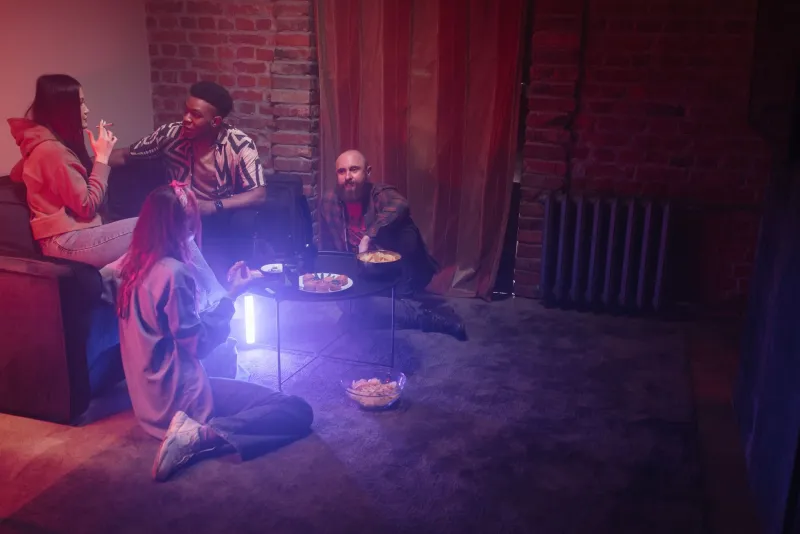
There is a Discord server — we won't tell you which one — dedicated entirely to the appreciation of a single fictional train conductor from a mid-2000s Canadian children's show. It has eleven members. It has been active for four years. Someone posted in it yesterday.
This is not an anomaly. This is, in fact, a thriving ecosystem.
While the rest of the internet keeps chasing virality, follower counts, and the fleeting dopamine hit of a trending post, a quietly growing number of people have made a deliberate choice to go the other direction. They have built communities so small, so specific, and so thoroughly invitation-gated that they might as well have a velvet rope and a bouncer named Derek who only lets you in if you can name three episodes from the show's second season.
Welcome to the world of intentional micro-communities — and yes, they are doing just fine without you.
Smaller Than Your Group Chat, More Active Than Your Group Chat
The average American adult belongs to somewhere between four and eight group texts at any given moment, at least two of which haven't been used since someone's cousin announced a baby shower in 2021. By contrast, the tiny Discord servers we're talking about — the ones with eight, twelve, maybe twenty members — post with a consistency that would embarrass most mid-size subreddits.
The reason, members will tell you, is the same reason a dinner party of six is more fun than a wedding reception of three hundred: everyone knows everyone, the conversation doesn't fracture into seventeen simultaneous threads, and there's no stranger in the corner loudly explaining why the thing you love is actually bad, actually.
One member of a server dedicated to cataloguing obscure regional fast food mascots from the 1980s and '90s described it as "the only place on the internet where I don't have to explain myself before I'm allowed to be excited about something." The server, which she joined after receiving a direct message from a stranger who had seen her comment in a much larger food history forum, has fourteen members and a pinned glossary of mascot terminology that runs to six single-spaced pages.
Six pages. For fast food mascots. We respect the commitment.
The Invite Is the Point
Here's the thing about these servers that the broader internet tends to misunderstand: the high barrier to entry isn't a bug. It's the entire design philosophy.
In the same way that a speakeasy is more fun than a chain bar partly because you had to know someone to get in, these micro-communities derive a significant portion of their value from the friction involved in joining them. You don't stumble into a server about restoration of vintage tabletop RPG modules from the 1970s via a Google search. You get there because you said something smart in another, slightly-less-obscure space, and someone noticed.
This self-selection process functions as a remarkably effective filter. Not for intelligence, necessarily — more for genuine investment. If you cared enough to find the breadcrumb trail that led here, you probably actually care about the thing. And if you actually care about the thing, you're probably not going to spend your first week in the server asking whether anyone has heard of the more popular version of the thing.
Several server administrators we spoke with — through channels we are absolutely not going to describe in detail — mentioned that they have turned down requests to join from people who seemed, on paper, to be exactly the right kind of fan. The reason, in most cases, was some version of "they felt like they wanted an audience more than they wanted a conversation."
In a content-creator economy built almost entirely on audience-seeking, that distinction is doing a lot of heavy lifting.
What Actually Happens in There
The content of these servers varies wildly, but the texture of them is surprisingly consistent. There are long, detailed conversations that read less like forum posts and more like the kind of thing that happens when you get four genuinely knowledgeable people in a room and give them something specific to argue about. There are collaborative projects — spreadsheets, wikis, shared documents — that would impress any professional archivist and would absolutely baffle anyone outside the community. There are in-jokes so layered and reference-dense that reading a server's history from the beginning feels like learning a new dialect.
One server, focused on a specific subgenre of experimental ambient music that peaked in a roughly three-year window in the early 2000s, maintains a shared listening queue that members contribute to asynchronously. Someone adds an album, someone else listens and annotates it, a third person responds to the annotations. The queue currently has 340 entries. The server has nine members.
Nine people. Three hundred and forty albums. Years of accumulated, cross-referenced listening notes.
You could publish that as a book and it would be the most authoritative document on the subject in existence. Instead it lives in a private Discord server where, by design, almost nobody will ever read it.
The Algorithmic Immune System
Ask members of these communities why they don't want to grow, and you'll get a version of the same answer delivered in different registers of exhaustion.
They've seen what happens when a small, good thing gets found. They've watched beloved subreddits calcify under the weight of new members who arrived after a viral post and never quite understood the culture. They've seen Discord servers that used to feel like a living room gradually transform into a convention floor — technically the same space, functionally unrecognizable.
Growth, in this framing, is not a success metric. Growth is what happens to you when you stop being careful.
This represents a genuine philosophical break from the dominant logic of internet culture, which has spent the better part of twenty years insisting that more is always better, that reach equals value, and that the goal of any community is to become a bigger community. The people building and maintaining these micro-servers are, whether they'd use this language or not, running a direct experiment against that assumption.
So far, the data looks pretty good for the contrarians.
The Unfindable Paradox
Here's the part where we acknowledge the obvious: writing about communities that are specifically designed not to be found is, at minimum, a little ironic. We are aware.
But the existence of these spaces — the fact that people are actively choosing smallness, intentionally building friction into their communities, and finding genuine satisfaction in a corner of the internet that the algorithm will never monetize — says something worth saying out loud.
Not everything on the internet wants to be discovered. Some of the best stuff, in fact, is specifically arranged so that you won't find it unless you deserve to.
The train conductor server is still posting. The fast food mascot server is still arguing about whether Noid counts as a mascot or a villain (it's both, obviously). The ambient music queue grows by one album every few days.
And somewhere, right now, someone is getting a Discord DM from a stranger who noticed a comment they left in a slightly larger space — and a door is opening that most people will never even know was there.